


Next-generation realistic visualization devices allow us to act in a completely natural way, breaking down any mental barriers or preconceptions: through technology, we can experience “today” what until “yesterday” was considered the future.
CETENA, an Italian maritime research and consulting company, has integrated these technological solutions to offer highly advanced digital solutions in the training sector.
In the field of simulation and training, where increasing levels of challenge and ever more complex geopolitical scenarios are reproduced, technical innovation is essential to maintain and consolidate the advantage built over the years.
CETENA, which, with the consultancy of AGMultivision, has implemented an advanced visualization system to make the simulated ship navigation scenario even more realistic and to provide high-performance training activities.
We tell you more about it in the story dedicated to this successful case history.
What we cover in this article:
- The role of technology in training according to CETENA
- The naval simulator: a highly immersive hyper-realistic experience
- The strategic objective of the project
- The consultancy of AGMultivision, a value-added innovation player

1) The role of technology in training according to CETENA
Today, technology plays a fundamental role in the development of complex projects, but also—and above all—in training. CETENA, a company of the Fincantieri Group, is strongly committed to training its resources: technology transfer, in fact, is a complex process aimed at identifying customer needs starting from the analysis of current skills, in order to enhance them and achieve the set objectives. It is precisely here that technology becomes a fundamental support.
Because technology makes it possible to do “today” what until “yesterday” was considered the future. “For those involved in applied research and the development of new technologies, this is a mantra,” says the CETENA team.
In the simulation and training industry, where increasing levels of challenge and ever more complex geopolitical scenarios are reproduced, cutting-edge technology is also essential to maintain and consolidate the advantage built over the years.
CETENA offers highly advanced digital solutions in the training sector because it focuses on careful training and a better understanding of the challenges related to digital technology.
There are, for example, courses based precisely on immersive learning, made possible through the use of a naval simulator based on virtual reality. This enables the learning of operational, maintenance, and procedural activities by making situations highly realistic.
And that value of training, at CETENA, is an important asset shared with the aim of improving learning processes in simulated environments to support the natural cognitive stimuli that would otherwise remain latent in theoretical training.
For this reason, technology is essential!
The human mind carries out cognitive processes to regulate its interaction with the reality it perceives. These involve directing conscious attention, processing stimuli, and assigning priorities to information. The mind itself orchestrates five primary qualities: will, attention, concentration, consciousness, and awareness.
Thanks to simulation, it is possible to work on these processes, making situations more familiar and accelerating training.
2) The naval simulator: a highly immersive hyper-realistic experience
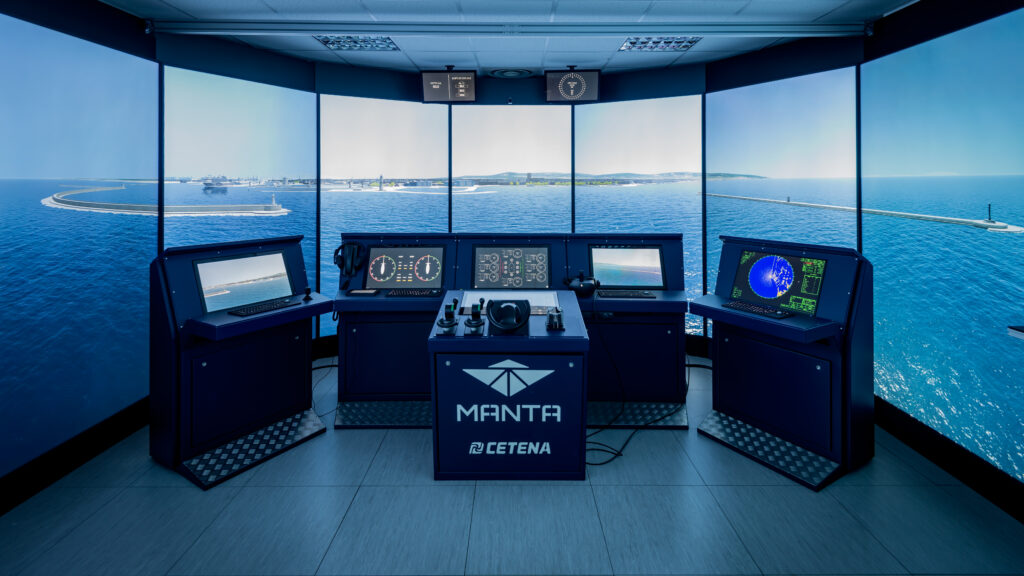
The full-scale naval simulator at CETENA becomes a reality.
Experience in the field of simulation and training, both civil and military, enables CETENA to adopt the necessary measures to stimulate awareness, through virtual reality, in every technological application.
The simulator developed at the Genoa headquarters, and in various training sites, allows, among others, pilots, crews, cadets, and Port Authorities to train with state-of-the-art tools. The new system replicates an entire bridge equipped with a fully functional and intuitive interface.
For Port Authorities, the use of these technologies is applied for the analysis and verification of port layouts, whether real or planned, for which scenarios and vessels are replicated. Experienced pilots are the key players in this activity because, thanks to their wealth of knowledge and the simulator’s accuracy, they verify both specific maneuvers and operational, technical, and environmental limits.
In the field of training, moreover, simulation allows operators to understand the complexity of the information they need to master, learning to manage it during dedicated training sessions aimed at true experiential preparation that facilitates their integration once in the field. Simulation is precisely the place where one can enhance their skills. It allows for mistakes, correction, and starting over, in order to reduce human error.
Virtual training therefore makes it possible to acquire a sense of confidence that would otherwise be impossible to reproduce, considering the economic impact and the risks if these activities were carried out in real life.
Such a realistic visualization system allows people to act in a completely natural way, removing any mental barrier or preconception.
There is, in fact, nothing that is not made easier through the possibility of repeating the same operations multiple times, in order to become familiar with those operations themselves.
3) The strategic objective of the project
For CETENA, technological innovation is fundamental because one of the key factors that unlocks the training potential of virtual reality is precisely realism. Humans tend to confuse the virtual with the real to the extent that they are engaged through their senses.
A highly realistic visualization system is therefore essential to achieving engagement, which in turn opens the doors of perception and facilitates learning.
The Fincantieri Group company found in AGMultivision a partner that shares its mission and was able to support the company in the technological evolution desired for training.
4) The consultancy of AGMultivision, a value-added innovation player
AGMultivision’s visual engineering department is the key player in the consultancy for CETENA and examined the idea of creating an advanced visualization system to make the simulated ship navigation scenario even more realistic.
An interesting challenge, especially from an educational and training perspective, because CETENA’s goal was to make the simulation experience “real,” rather than just realistic.
In analyzing the requirements and specific needs of this project, AGMultivision proposed the use of 98″ professional displays with 4K resolution in portrait orientation, the best choice from a quality standpoint.
The product choice fell on Philips PPDS not only for its quality, but also for the guarantee of specialized technical support from the manufacturer, which—for example—directly handled, with the support of the AGMultivision team, the calibration operations to ensure color consistency across the displays (color matching).
Among professional display providers, AGMultivision has proven over the years to be a reliable partner, ready to offer fast and competent technical support during the pre-sales, installation, and post-sales phases.
This characteristic is probably the best guarantee for a client developing professional systems where operational continuity is a critical factor.
Do you have a project to carry out?
Contact our customer service and we will find the solution best suited to your needs thanks to our selection of partners who can provide innovative technological solutions, enhanced by our professional consultancy.
To stay up to date with our news, follow us on social media.
We look forward to seeing you on Facebook and on LinkedIn.